How to Use Your CRM to Maximize Nonprofit Fundraising
What is a CRM?
For nonprofits, a CRM is an essential fundraising tool. With over 2 million nonprofits in the U.S., donors have an endless choice of causes to support.
A CRM, or customer relationship management software, is used by companies all over the world to track client data, gather insights, and build strategic sales and communication plans.
While your mission is what brings donors through the door, your relationship with them is what keeps them coming back. Your CRM is what empowers you to build and grow that relationship.
Nonprofits that use CRMs effectively can expect to boost their fundraising revenue by over 20%, with popular systems like Bloomerang reporting numbers much higher.
If you’re using a CRM but you’re not getting the same results, there’s hope. In this blog, we’ll explore the most powerful features your CRM can offer, and how to use them to raise more for your nonprofit.
The Nonprofit Infrastructure Gap
Most nonprofits invest in their CRM with good intentions. They want a better system that will help them prioritize donor relationships.
Unfortunately, it’s not the platform that makes this happen. If your internal infrastructure doesn’t support growth, your CRM will just continue gathering dust.
These common mistakes limit your results:
Treating the CRM as a donation log instead of a relationship management system
Entering data inconsistently, making reports unreliable
Leadership makes decisions outside the CRM instead of using it as a guide
When teams fall into these patterns, the CRM stores information but doesn’t drive action.
With the right infrastructure, a CRM can help you:
Track prospects
Deepen your relationship with donors
Be strategic in your outreach
The reality is that most development teams don’t have the bandwidth to make this happen.
CRMs for Small & Growing Nonprofits
Sprout Fundraising & Consulting helps clients do more with their CRM through our Rooted Infrastructure Build. In addition to SproutTable, a CRM for small organizations, many of our larger nonprofit clients use Bloomerang.
When fully optimized, these CRMs function as relationship intelligence systems, not just as transaction logs.
For example, Bloomerang’s features include:
Custom Donor Fields: These can be used to track the information your organization needs, including bios, interests, wealth indicators, and relationship notes in each donor profile
Wealth Screening: Their DonorSearch integration can identify real major gift prospects within your existing database
Task and Scheduled Reports: Create accountability without requiring someone to remember everything
Penny: Bloomerang's new AI Assistant acts as a strategic partner
These features are great on paper, but they’re only useful when your data is organized. We build the systems nonprofits need to fundraise strategically, not reactively.
3 Ways to Make an Impact with Your CRM
The bottom line: you need infrastructure to use your CRM effectively. No matter your platform, we recommend following these 3 principles:
1. Stop storing relationship intelligence in transaction notes.
When notes are buried in gift records, it’s nearly impossible to find them. Instead, build custom fields like donor bios and affinity interests that live in donor profiles where any team member can access them.
2. Assign every major prospect a solicitation stage.
Donor stages show you who needs attention and what kind. They make it possible to build a coherent outreach plan. Without stages, donor management is reactive; with them, it’s strategic.
3. Let your CRM feed your leadership, not the other way around.
Build reports that outline who needs a touchpoint and set up weekly automated reminders. A well-built CRM should reduce decision fatigue for Executive Directors and Development Directors.
Bloomerang Case Study: Rooted Infrastructure Build & Data Cleanup
One nonprofit recently contacted us after experiencing fundraising staff turnover. With limited systems in place, they relied on individuals’ institutional knowledge to power their fundraising strategy.
When those employees left, so did that knowledge.
Despite the setback, they were determined to build out their major gifts program. The problem was that they had 15,000 records in Bloomerang but almost no clarity about the data.
The good news is they had the data, they just couldn’t see it yet. We helped them get there with our Rooted Infrastructure Build, a customized CRM setup and donor cleanup service.
First, we customized their donor fields to capture the right information, including donor bios, relationship notes, and wealth indicator summaries.
Then, we built on that strong foundation with:
A DonorSearch wealth screening to identify high-capacity donors
Email click data to flag prospects who were already engaging
A stewardship communication calendar
A leadership outreach strategy to engage 5 donors per week
By March, the nonprofit was already 36% of the way to their individual giving goal.
We then helped them use Bloomerang’s AI assistant, Penny, to supercharge their momentum.
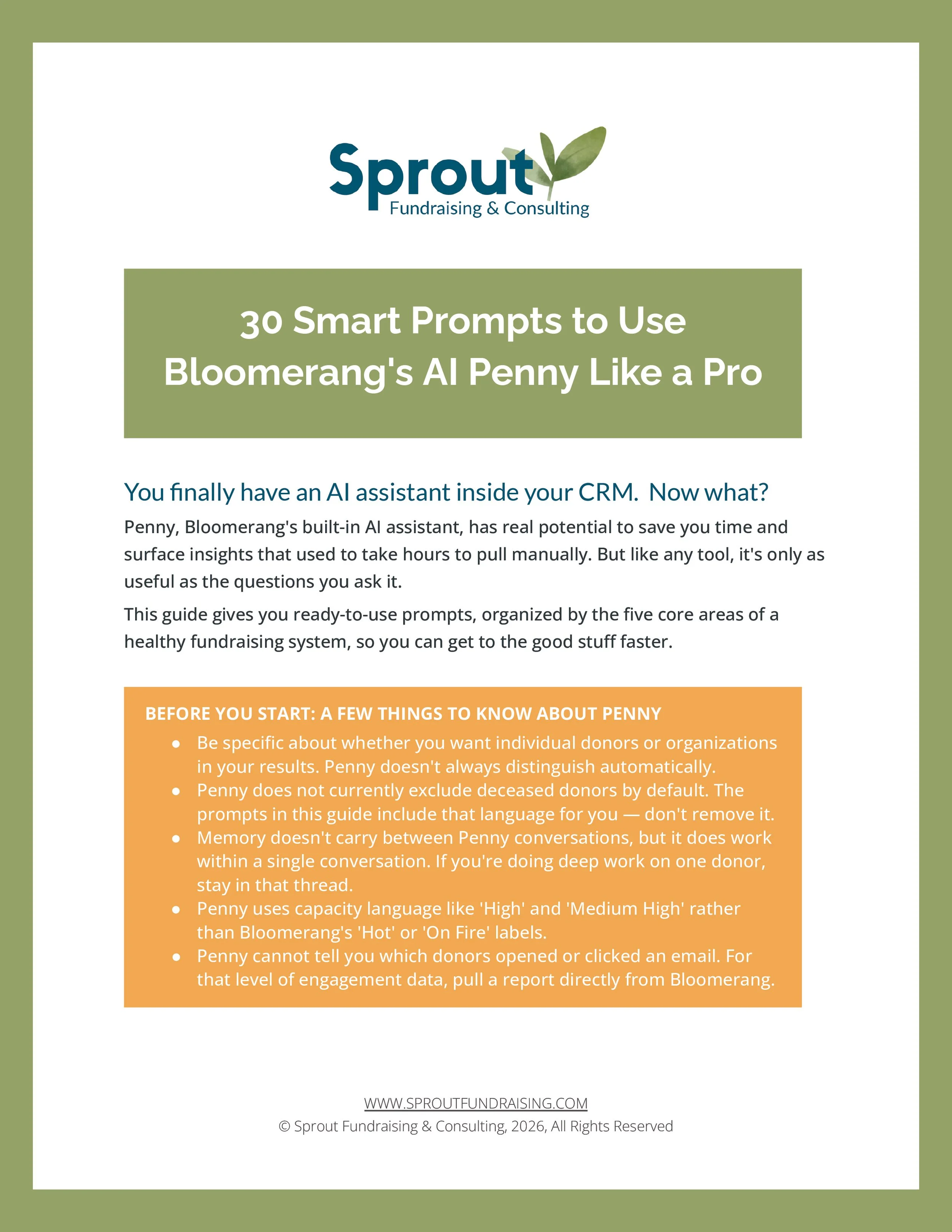
Inspired by this success, we created 30 prompts for improving fundraising efficiency with Penny, which you can download here for free.
Get More Out of Your CRM
Implementing these concepts takes time that most development teams don’t have. That’s exactly what the Rooted Infrastructure Build solves.
We handle the database setup and deliver a system that actually works, with custom fields, wealth screening, and a weekly rhythm your team can sustain.
Curious to learn more? Book a free consultation with our team. Year-end giving season is right around the corner—it's time to put your data to work.